Skip to content

Satellite TV Guides

  • Home
  • Satellite Dish Installation
  • LNB Technology & Troubleshooting
  • Satellite TV Troubleshooting
  • Satellite Technology & Standards
  • Satellite Software & Configuration
Satellite TV Guides
  • Satellite TV Technology Trends in 2026
    Satellite Technology & Standards

    Satellite TV Technology Trends in 2026

    Byadmin September 30, 2026September 30, 2026

    Satellite TV keeps evolving. In 2026 the main trends are familiar themes: more UHD, better compression, and ever more efficient transponders. Here is what is shaping the year. More 4K and UHD Channels The number of free-to-air and paid 4K channels continues to grow, delivered over DVB-S2X and HEVC. Viewers with older HD-only boxes are…


    Read More Satellite TV Technology Trends in 2026Continue

  • What Is DiSEqC? Digital Satellite Equipment Control Standard
    Satellite Technology & Standards

    What Is DiSEqC? Digital Satellite Equipment Control Standard

    Byadmin September 30, 2026September 30, 2026

    DiSEqC is the language your receiver uses to control switches and motors on the dish. If you have ever set “DiSEqC 1.0” or “DiSEqC 1.2” in a menu, this is what it means. What DiSEqC Does Instead of extra control cables, DiSEqC sends brief digital pulses down the same coax. The receiver tells the switch…

    Read More What Is DiSEqC? Digital Satellite Equipment Control StandardContinue

  • HEVC/H.265 vs H.264: Video Codecs for 4K Satellite
    Satellite Technology & Standards

    HEVC/H.265 vs H.264: Video Codecs for 4K Satellite

    Byadmin September 30, 2026September 30, 2026

    The video codec decides how much picture fits into a given bitrate. H.264 powered the HD era; HEVC (H.265) is the codec behind 4K UHD satellite. Knowing the difference explains why your old HD box cannot play new UHD channels. H.264 (AVC): The HD Workhorse H.264 has been the standard for satellite HD for fifteen…

    Read More HEVC/H.265 vs H.264: Video Codecs for 4K SatelliteContinue

  • Encryption and Conditional Access in Satellite TV
    Satellite Technology & Standards

    Encryption and Conditional Access in Satellite TV

    Byadmin September 30, 2026September 30, 2026

    Satellite channels are either free-to-air (FTA) or encrypted. Encrypted channels use a system called conditional access — and understanding it explains why some channels just work and others ask for a card. Free-to-Air (FTA) FTA channels are broadcast unencrypted. Any receiver with a dish pointed at the right satellite can watch them, no subscription needed….

    Read More Encryption and Conditional Access in Satellite TVContinue

  • Uplink vs Downlink: How Satellite TV Works
    Satellite Technology & Standards

    Uplink vs Downlink: How Satellite TV Works

    Byadmin September 30, 2026September 30, 2026

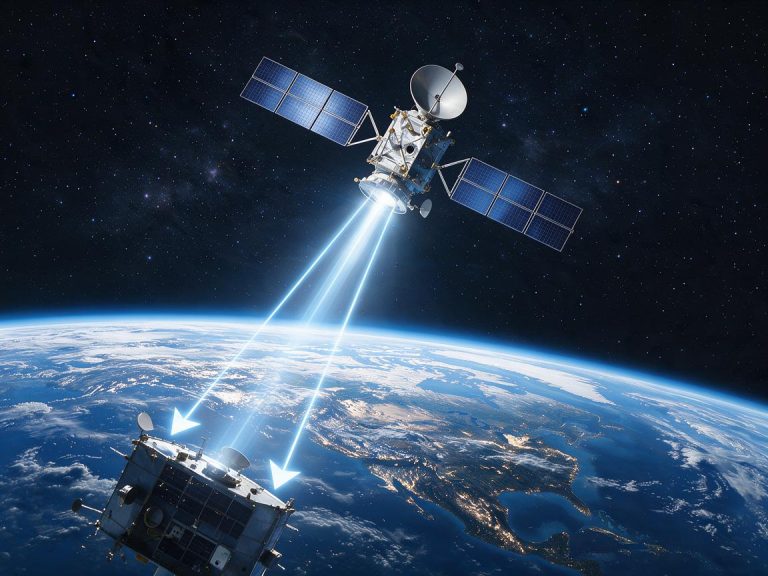
    Satellite TV is a two-way radio link: content is beamed up to the satellite, then beamed back down to you. Understanding the uplink and downlink helps make sense of the whole system. The Uplink Broadcasters send their programme from a ground station (an uplink dish) up to the satellite at a high frequency. The satellite…

    Read More Uplink vs Downlink: How Satellite TV WorksContinue

  • What Is L-Band in Satellite Reception?
    Satellite Technology & Standards

    What Is L-Band in Satellite Reception?

    Byadmin September 30, 2026September 30, 2026

    “L-band” is the frequency range that runs down the coax from your dish to the receiver. It is the intermediate frequency between what the satellite sends and what your receiver ultimately uses. Where L-Band Sits The satellite broadcasts at 10–12 GHz (Ku band). That is too high for ordinary coax. The LNB translates it down…

    Read More What Is L-Band in Satellite Reception?Continue

  • Satellite Footprints and Coverage Maps Explained
    Satellite Technology & Standards

    Satellite Footprints and Coverage Maps Explained

    Byadmin September 30, 2026September 30, 2026

    A satellite footprint map shows where the satellite's signal reaches on Earth — and how strongly. Before you install a dish or buy a receiver, reading a footprint map saves you a lot of guesswork. What a Footprint Map Shows Contour lines on the map connect points of equal signal strength (EIRP). The inner contour…

    Read More Satellite Footprints and Coverage Maps ExplainedContinue

  • DVB-S2X: The Next Generation of Satellite Broadcasting
    Satellite Technology & Standards

    DVB-S2X: The Next Generation of Satellite Broadcasting

    Byadmin September 30, 2026September 30, 2026

    DVB-S2X is the newest major satellite broadcast standard, and it is the reason 4K UHD satellite TV exists. It is an extension of DVB-S2, not a replacement — but it adds enough efficiency to matter. What S2X Adds DVB-S2X introduces finer modulation options (16APSK, 32APSK), improved filtering, and better error correction. The result is around…

    Read More DVB-S2X: The Next Generation of Satellite BroadcastingContinue

  • Multistream Receivers: Watching Multiple Signals on One Transponder
    Satellite Technology & Standards

    Multistream Receivers: Watching Multiple Signals on One Transponder

    Byadmin September 30, 2026September 30, 2026

    Some modern satellite transmissions use a technique called multistream, where several independent data streams share one transponder. To watch them you need a multistream receiver. Here is what it means in practice. What Is Multistream? Instead of one broadcaster using a whole transponder, several operators can share it using the DVB-S2 multistream feature. Each stream…

    Read More Multistream Receivers: Watching Multiple Signals on One TransponderContinue

  • What Is Bandwidth in Satellite Communications?
    Satellite Technology & Standards

    What Is Bandwidth in Satellite Communications?

    Byadmin September 30, 2026September 30, 2026

    Bandwidth is one of those words used loosely. In satellite TV it has a precise meaning: how much of the radio spectrum a transponder occupies, and how much data it can carry. Bandwidth as Spectrum Width A transponder occupies a slice of the downlink frequency band — say 11,836 MHz plus/minus 18 MHz. That 36…

    Read More What Is Bandwidth in Satellite Communications?Continue

Page navigation

Previous PagePrevious 1 2 3 4 5 6 … 12 Next PageNext

© 2026 Satellite TV Guides | About Us | Contact | Privacy Policy | Disclaimer

  • Home
  • Satellite Dish Installation
  • LNB Technology & Troubleshooting
  • Satellite TV Troubleshooting
  • Satellite Technology & Standards
  • Satellite Software & Configuration